
Although demolition on construction sites is usually selective, in practice it is often the case that stone rubble taken to sorting centers is still contaminated with remnants of wood, plastic and other construction waste. In order to produce high-quality mixed or stone rubble, it is essential to carefully remove these materials.
Screened and cleaned mixed rubble
However, this is not a problem for the WS 1400 windshifter. The operating principle of a windshifter, also called a wind sifter, uses air pressure. A precisely directed airflow on the supplied, contaminated fraction causes the lighter particles to be blown away from the heavier fraction, such as stone or concrete rubble, and these are collected in a disposal container.
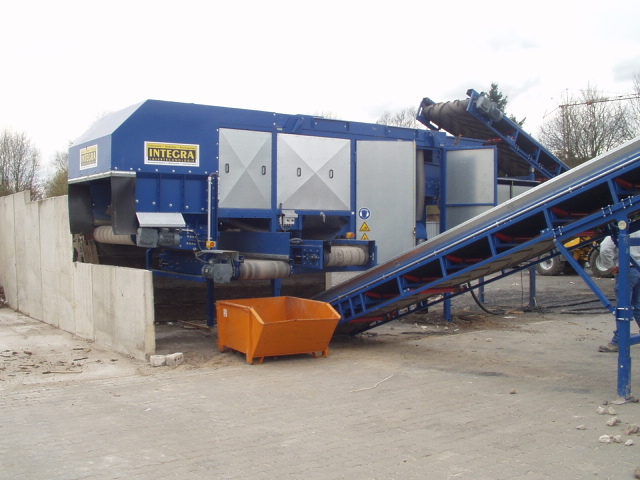
To achieve a good result in this process, the material to be treated must first be screened with a flat deck screening machine so that the fine fraction is completely removed. This is absolutely necessary because this sand fraction would otherwise be blown out along with the residual fraction. The goal is to keep the light waste fraction as light as possible in order to minimize disposal costs.
Therfore, to efficiently wind sift, it is absolutely necessary to supply the machine with perfectly screened input material.
The process starts by extracting the soil, specifically the 0/20 mm fractions and the excess 60/plus, from the material. The 20/56 mm intermediate fraction then undergoes separation by a wind sifter, separating the light waste fraction from the stones. The final result is a 100% pure 20/56 mm stone fraction.


