
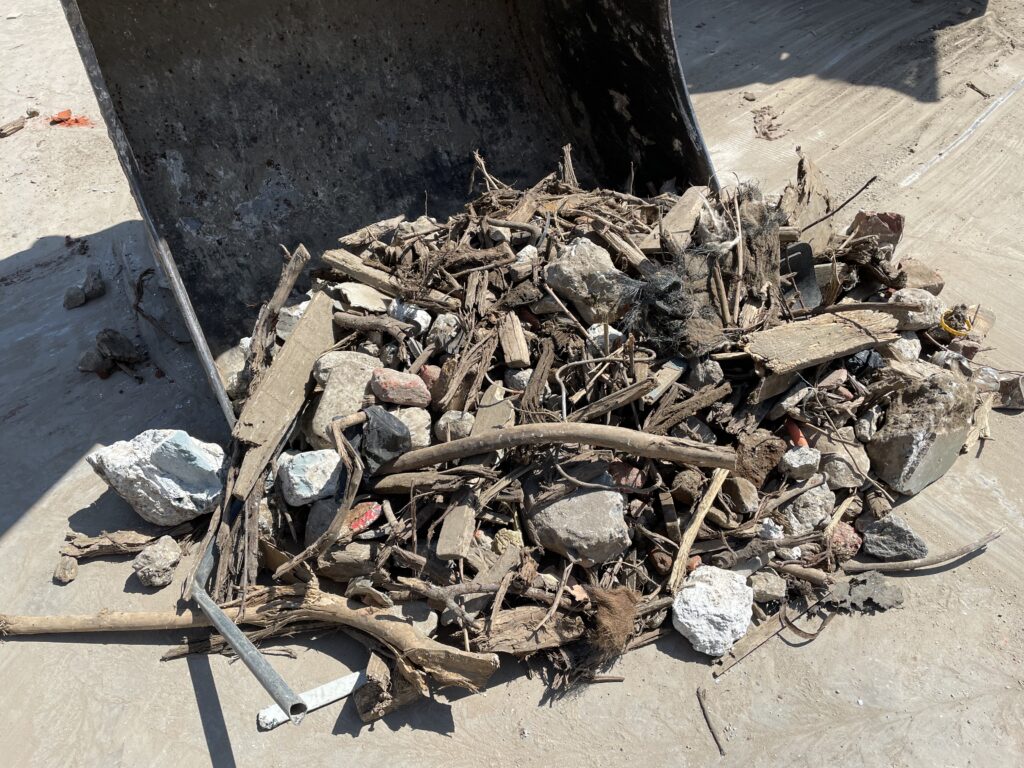
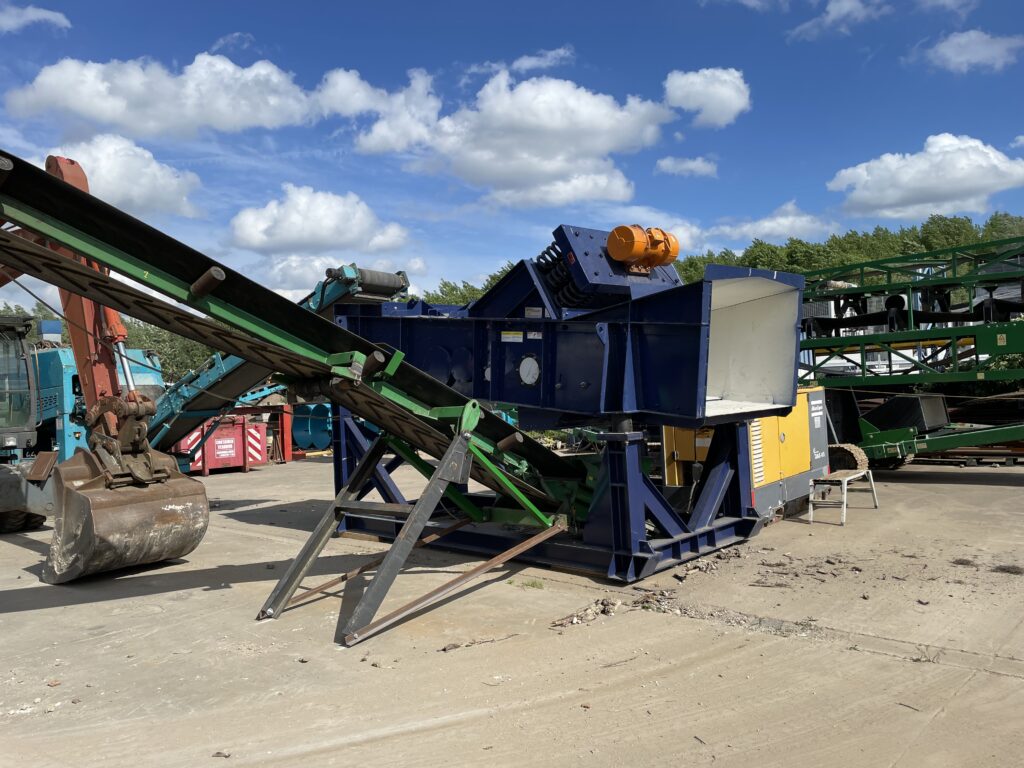
Construction and demolition waste sorting with General Kinematics’ patented DE-STONER® Air Classifier. It is designed for continuous high-volume production in a wide range of dry separation applications… and is a lower cost alternative for removing unwanted “lights” from recovered material streams.
The completely dry system is capable of processing a wide range of waste materials. The combination of vibration action and high-speed, low-pressure airflows work together to aerate and stratify materials based on differences in final velocity.
BENEFITS:
-
- Eliminates environmental hazards associated with material separation using water.
-
- Easily adjustable to achieve different degrees of separation.
-
- Suitable for a diverse range of products.
Blockage resistant. Material flow does not come into contact with moving parts.
Low energy consumption thanks to GK’s proven Two-Mass Design, resulting in a low-power motor. Fully isolated design minimizes the need for foundation requirements. Robust and durable, designed for long service life. Test capabilities are available.
SUCCESFUL SEPARATION AND CLASSIFICATION APPLICATIONS INCLUDE:
-
- RDF fuel
-
- Glass
-
- Mixed materials
-
- Shredded MSW (municipal solid waste)
-
- Shredded scrap with residual waste
-
- Biomass fuel
-
- Wood
HOW IT WORKS:
- Vibrational action moves the material, with high-density substances sinking to the bottom of the trough.
- An optional dropout section for fine particles removes smaller particles, such as broken glass or dirt, before they reach the air nozzle.
- In the air fluidization section, air is blown through the material, creating turbulence to promote material stratification.
- The material transports over the air knife into the air stream. Heavier materials fall through the airflow into the discharge chute.
- Material with marginal density falls onto the adjustable landing plate and return to the discharge chute.
- Light materials are carried past the landing plate and transported to the end of the DE-STONER®.
- Ultralight materials, such as thin film or paper, are directed into the product discharge zone in the air stream.
Summary
Vibrations: The natural frequency design of two masses liberates materials and effectively disperses them throughout the unit.
Aeration: Prepares the material bed for the air knife by inducing turbulence, promoting stratification of materials and releasing the lighter elements located under heavier objects.
Classification: The air knife provides the final separation, paying attention partly to density and partly using aerodynamics to achieve optimal results.
Available in models for separating two to five fractions, the DE-STONER® is adaptable to a wide range of materials, handles large volumes and exhibits practical resistance to blocking. Vibration action moves the material while lighter materials are discharged to the drop-out box.
FEATURES:
-
- Excellent performance guarantee reliable removal of unwanted “light” elements from recycled scrap metal.
-
- Lower compressed air requirements and operating costs compared to conventional “Z-Box-style” classification equipment.
-
- Fully insolated design to minimize the need for foundations.
-
- Easily adapted to your specific requirements for separation and classification.
-
- Reliable, energy-saving PARA-MOUNT II® Two-Mass, natural frequency vibration drive.
Separating construction and demolition waste with Naessens Hydraulics


